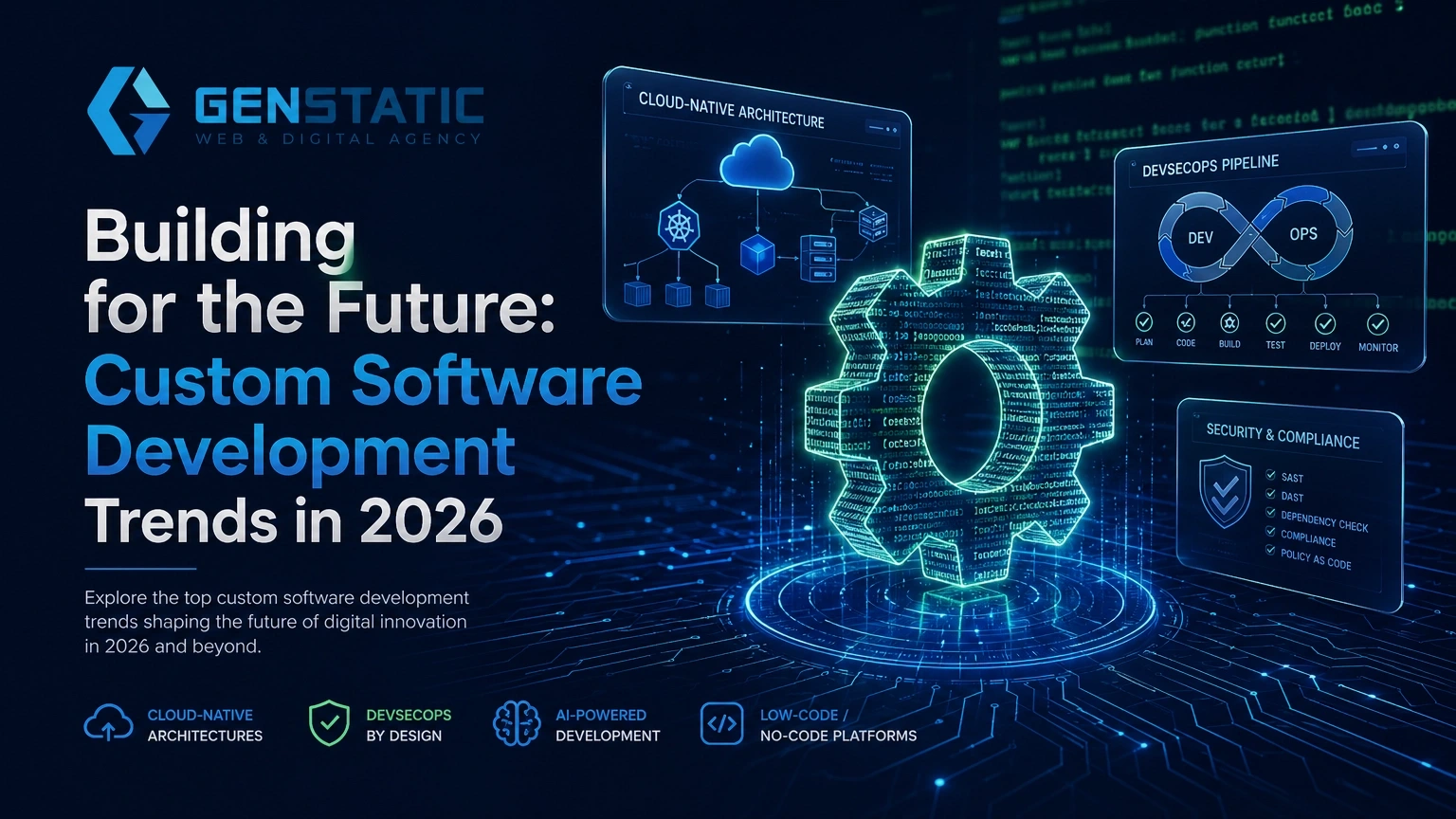
Building for the Future: Custom Software Development Trends in 2026
Introduction
In an era where off-the-shelf solutions often fall short of meeting unique business needs, custom software development is more critical than ever. As we move through 2026, the landscape of bespoke software is being reshaped by emerging technologies and methodologies designed to deliver scalable, secure, and highly tailored solutions. At GenStatic, we specialize in building custom software that not only solves today’s challenges but is engineered to adapt to tomorrow’s opportunities.
1. AI-Assisted Development and Code Generation
Artificial Intelligence is revolutionizing the software development lifecycle. In 2026, AI-assisted development tools are becoming standard practice, significantly accelerating the coding process and improving code quality .
- Intelligent Code Completion: AI models suggest code snippets, entire functions, and even complex algorithms based on context, reducing manual typing and errors.
- Automated Testing and Debugging: AI tools can automatically generate test cases, identify vulnerabilities, and suggest fixes, ensuring robust and secure software.
- Faster Time-to-Market: By automating repetitive tasks, development teams can focus on complex logic and architecture, bringing custom solutions to market faster.
2. Cloud-Native Architecture and Serverless Computing
The shift towards cloud-native architecture and serverless computing continues to dominate custom software development. This approach allows businesses to build and run applications that exploit the advantages of the cloud computing delivery model .
- Unmatched Scalability: Serverless applications automatically scale up or down based on demand, ensuring optimal performance without the need to manage infrastructure.
- Cost Efficiency: Businesses only pay for the compute time they consume, eliminating the costs associated with idle servers.
- Microservices: Breaking down applications into smaller, independent services (microservices) makes them easier to develop, deploy, and maintain.
3. Low-Code/No-Code Platforms for Rapid Prototyping
While complex enterprise systems still require deep coding expertise, low-code and no-code (LCNC) platforms are playing a crucial role in rapid prototyping and building internal tools .
- Accelerated Prototyping: LCNC platforms allow businesses to quickly build functional prototypes to validate ideas before committing to full-scale custom development.
- Empowering Citizen Developers: Non-technical staff can create simple applications to automate their workflows, freeing up professional developers for more complex tasks.
- Integration Capabilities: Modern LCNC platforms offer robust APIs to integrate seamlessly with existing custom software and legacy systems.
4. Enhanced Cybersecurity and DevSecOps
With cyber threats becoming more sophisticated, security is no longer an afterthought but a foundational element of custom software development. The integration of security practices into the DevOps pipeline—known as DevSecOps—is standard in 2026 .
- Security by Design: Security considerations are integrated from the initial planning stages through to deployment and maintenance.
- Automated Security Testing: Continuous security testing is embedded into the CI/CD pipeline, identifying vulnerabilities early in the development process.
- Zero Trust Architecture: Implementing a “never trust, always verify” approach ensures that every access request is authenticated and authorized, regardless of its origin.
Conclusion
Custom software development in 2026 is defined by speed, scalability, and security. By leveraging AI-assisted coding, embracing cloud-native architectures, utilizing LCNC platforms for rapid prototyping, and embedding DevSecOps practices, businesses can build bespoke solutions that drive innovation and competitive advantage. At GenStatic, we are committed to mastering these trends to deliver custom software that perfectly aligns with your unique business goals and prepares you for the future.